
Introduction to Abaqus XFEM
Modelling Crack Initiation and Propagation Without Predefined Crack Paths
11 March 2027 at 15:00:00
Time & Location
11 Mar 2027, 15:00 – 16:00 CET
Online Training
About the Event
Why Traditional Crack Modelling Falls Short
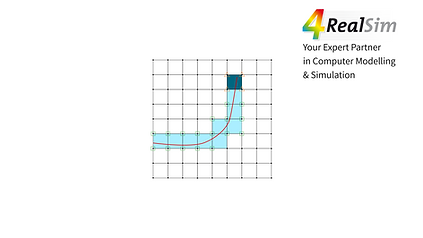
Classical fracture modeling techniques only allow a crack to propagate along predefined element boundaries, which means the crack path needs to be known in advance, and meshing around it is often time consuming to set up. In many real problems, especially where crack initiation location and propagation direction are not known upfront, this constraint makes traditional approaches impractical or requires excessive remeshing effort as the analysis progresses.
Webinar Scope
In this online training, 4RealSim will introduce the Extended Finite Element Method (XFEM) in Abaqus, a technique that allows cracks to be located within the interior of an element, independent of the mesh. Participants will learn the basic concepts behind XFEM, how damage is modelled using both cohesive and LEFM based approaches, how to build an XFEM fracture model from scratch, and see real examples covering crack initiation, low cycle fatigue, mixed mode propagation, and delamination.
Topics Covered
Fracture mechanics fundamentals: fracture modes and the stress intensity factor
Limitations of traditional crack modeling methods
XFEM basics: mesh independent crack modeling and its advantages
Core XFEM ingredients: displacement enrichment and the level set method
Contact modelling on XFEM based crack surfaces
Damage modelling: cohesive damage versus LEFM based damage (VCCT)
Building an XFEM fracture model: damage criteria, enrichment regions, and analysis controls
Output quantities for visualizing and evaluating cracks (PHILSM, STATUSXFEM)
Example applications: crack initiation and propagation, low cycle fatigue, mixed mode propagation, delamination, and contour integrals
Known limitations of XFEM modeling
Who Should Attend?
Simulation engineers modelling fractures, cracking, or delamination
Analysts working on structures where crack location or path is not known in advance
Engineers dealing with composite failure, fatigue cracking, or bond line fracture
Anyone frustrated by the meshing effort required for traditional crack modelling approaches
Prerequisite
4RealSim Abaqus customer
